
Victoria Resort's Signature Retreat Package

Before Baby Arrives, Take a Little Time for Just the Two of You

🍂 Your Fall Color Adventure Is Already Planned Fall in Southwest Michigan should feel like crisp air, brilliant colors, winding country roads, and discovering something new around the next corner. But planning the perfect fall color tour can quickly become work. Which roads should you take? Where are the best views? Where should you stop? Which winery, orchard, or trail is worth your time? Before you know it, you’re spending more time researching than enjoying your getaway. At Victoria Resort , we believe your fall getaway should be easier than that. That’s why we created the Victoria Resort Signature Fall Color Tour . We’ve planned the route, chosen the experiences, and written out the driving directions. You simply grab a warm drink, turn on your favorite fall playlist, and go. We planned the adventure. You get to enjoy the ride. A Fall Day With Something New Around Every Corner You’ll start along the shores of Lake Michigan , where brilliant reds, oranges, and golds meet the deep blue water. Get out of the car, breathe in the crisp air, and take a short walk through the changing leaves to a beautiful view overlooking the lake. Then the scenery changes. Soon, you’ll find yourself surrounded by rows of vines and colorful countryside as you discover Michigan wine . Stop for a tasting. Try something new. If you find a bottle you love, bring it with you. You may want it later. Your directions will lead you on, and this time you'll leave the car behind for a while. You’ll walk beneath the fall colors , surrounded by wooded dunes and a canopy of red, orange, yellow, and gold. Listen to the leaves crunch beneath your feet and enjoy being right in the middle of Michigan's colorful fall scenery. Then comes the challenge. 303 wooden steps. Climbing them is optional, but if you decide to take them on, you'll have quite a story to tell. Pass step 100. Keep going past 200. Reach 303, catch your breath, and look out over the colorful landscape around you. Take the picture. You earned this one. Taste Michigan Harvest Season After your climb, the adventure changes again. You'll leave the dunes behind and find yourself traveling along country roads surrounded by farms and orchards. Now you're experiencing Michigan harvest season . This is where fall becomes something you can taste. Fresh apples. Cider. Homemade pie. Pick up a bag of apples. Have some cider. Enjoy a piece of pie—and you might want to take another piece with you for later. Then you'll continue through the countryside until you find yourself among the vineyards one more time. Slow down, enjoy the scenery, taste a Michigan wine, and find a bottle you'd like to bring back with you. By the end of the day, you'll have experienced Lake Michigan, Michigan wine country, wooded dunes, brilliant fall colors, 303 wooden steps, apple orchards, harvest season, and vineyards. And you didn't have to plan any of it. Your Plan Is Simple When you stay at Victoria Resort during fall color season, we'll help make your adventure easy: Stay at Victoria Resort. Follow your Victoria Resort Signature Fall Color Tour. Explore, taste, walk, climb, and enjoy the day—then follow the route right back home to the resort. No wondering where to go next. No spending the morning building an itinerary. Just follow the directions and see what waits around the next corner. 🍎 Then Bring a Little of the Adventure Home At the end of the tour, your directions bring you right back to Victoria Resort . Park the car. Bring in the apples. Bring in the pie. Bring in that bottle of wine you discovered along the way. Then settle in. Warm up by the fireplace. Relax in the sauna. Pour a glass of wine. Cut a piece of pie. Put your feet up and decide which part of the day was your favorite. Maybe it was standing above Lake Michigan surrounded by fall color. Maybe it was walking beneath the leaves. Maybe it was discovering a new Michigan wine or experiencing harvest season. Or maybe it was reaching step 303 when you weren't entirely convinced you would make it at step 187. Whatever your favorite moment turns out to be, you get to make the memories without having to make the plan. 🍁 Victoria Resort Signature Fall Color Tour You bring your sense of adventure. We’ll give you the route. We planned the adventure. You get to enjoy the ride.


Experience the Victoria Resort Wine Loop
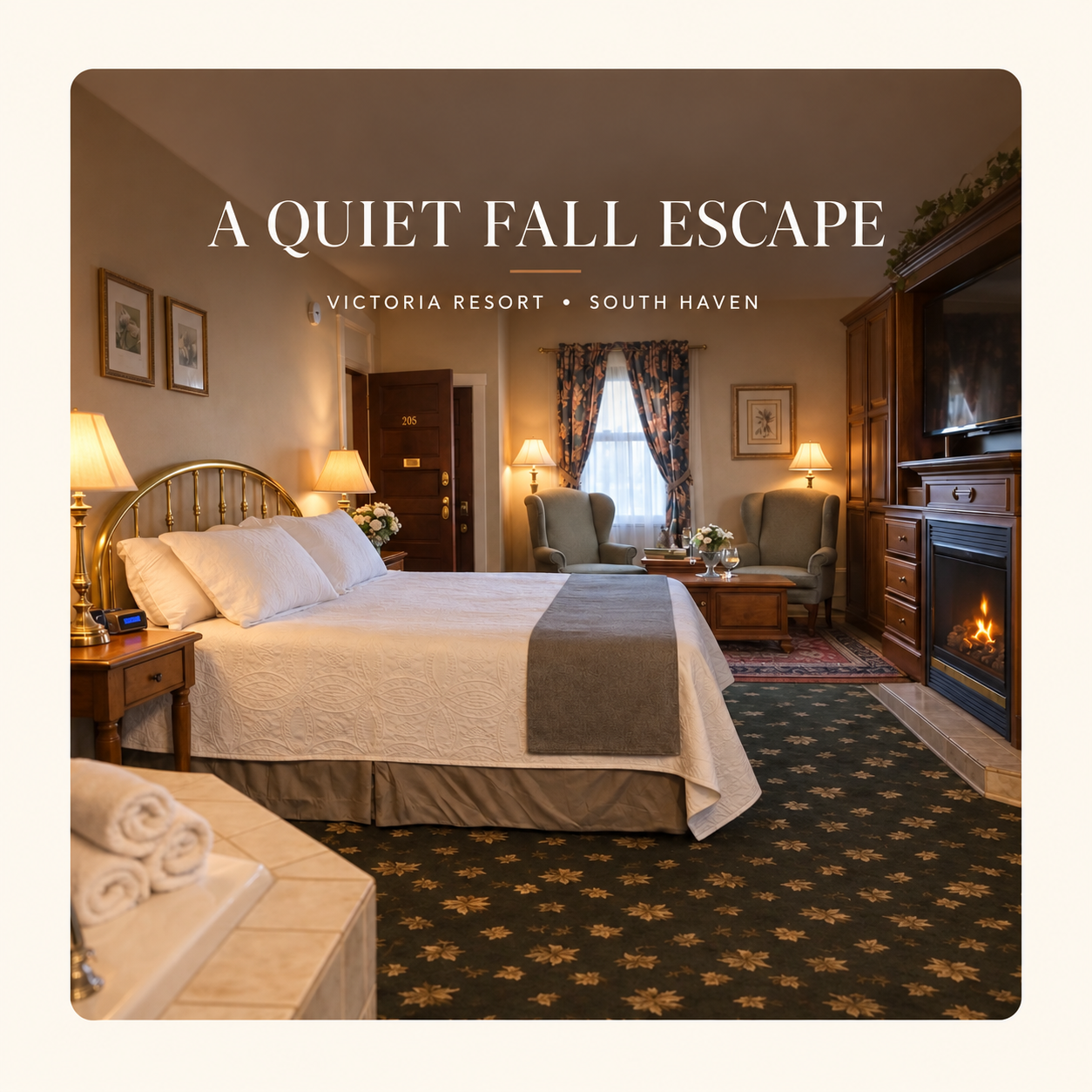
A Quiet Fall Getaway Near Lake Michigan


Presented by Victoria, Your South Haven Weekend Guide

You want to play confident, consistent pickleball—especially when tournament pressure rises. But too many balls into the net or out of bounds can quickly turn a competitive game into a frustrating loss. The solution is not simply hitting harder or trying to create more winners. It is learning to own the high-percentage zone . At Victoria Resort in South Haven, Michigan, we define the “80% zone” as the large interior portion of the pickleball court away from the sidelines and baseline. Aiming within this zone gives you more margin over the net, reduces unforced errors and forces your opponents to hit another ball. These three pickleball consistency drills use a simple challenge: complete 100 successful shots . By practicing for long streaks instead of quick winners, you can build dependable shots that hold up during recreational games, competitive play and pickleball tournaments. 1. Crosscourt Dink Endurance Crosscourt dinking is one of the highest-percentage shot patterns in pickleball. The ball travels over the lower part of the net and has more court to work with than it would on a straight-ahead dink. Place cones in the middle section of the crosscourt kitchen, approximately 18–24 inches inside the sideline and kitchen line. Then dink cooperatively with a partner, counting every ball that lands inside the target. The goal is to complete 100 consecutive successful dinks . If either player hits the ball into the net, out of bounds or outside the target area, restart the count at zero. Practice three variations: Forehand dinks Backhand dinks Alternating forehand and backhand dinks Use a relaxed grip and give the ball enough arc to clear the net comfortably. The purpose is not to skim the tape or create a winner. It is to develop a repeatable pickleball dink that remains dependable under pressure. A helpful thought is: “Lift, arc and land inside.” 2. The Transition-Zone Reset The transition zone—often called “no-man’s-land”—creates many unforced errors. Players frequently try to attack difficult balls near their feet instead of using a soft reset to neutralize the pressure. A dependable transition-zone reset gives you time to recover, move forward and reach the kitchen line. One player begins at the kitchen line while the practicing player stands in the transition zone. The kitchen player feeds controlled volleys toward the practicing player’s feet. The practicing player resets each ball softly into the middle third of the kitchen. Count every successful reset that lands low and safely inside the target. The goal is to complete 100 successful resets . If a reset goes into the net, out of bounds or sits high enough to be attacked, restart the count at zero. Change positions during the drill so the practicing player learns to reset from different areas of the pickleball court: Near the baseline In the middle of the transition zone Just behind the kitchen line From both the left and right sides of the court Keep your grip light, use very little backswing and allow the incoming pace to rebound from your paddle. A reset landing in the center of the kitchen provides much more safety than one aimed close to a sideline. Remember: “Soft middle, then move.” 3. The Four-Shot Safety Pattern Many pickleball rallies are shaped during the first four shots. This 100s Game develops a safe, dependable pattern for beginning each point: Serve deep with room inside the baseline. Return deep through the middle. Drop the third shot into the center of the kitchen. Volley or dink the fourth shot back into the kitchen. Mark generous target areas with cones. Keep the deep targets approximately three feet inside the baseline and place the third-shot drop target in the center portion of the kitchen. Each completed pattern contains four shots. The goal is to complete 25 clean patterns for a total of 100 consecutive successful shots . After the fourth shot, stop the rally, switch serving sides and begin the next pattern. Count every successful shot. If any ball goes into the net, out of bounds or outside its designated safe zone, restart the count at zero. Alternate roles regularly so both players practice every part of the sequence: Serving deeply with margin Returning deep through the middle Dropping safely into the center kitchen Controlling the fourth shot into the kitchen Do not increase the pace simply because the count is rising. Use the same controlled technique on shot 100 that you used on shot one. This drill reinforces an important lesson: high-percentage pickleball is not passive pickleball. A deep return, low third-shot drop or well-placed middle ball can pressure your opponents without requiring a risky shot. The goal is simple: 25 complete patterns, 100 successful shots and no free points. How to Own the High-Percentage Zone in Pickleball Tournaments Tournament pressure can tempt players to hit harder, aim closer to the lines and attempt winners too early. Owning the high-percentage zone means trusting the safer patterns practiced in these 100s Games—especially when the score becomes tight. During a neutral rally, imagine a boundary approximately three feet inside the outer lines. Play primarily within this smaller target area until your opponents give you a clearly attackable ball. A neutral rally is the part of a point in which neither team has a clear advantage. Everyone is reasonably balanced, and the ball is at or below net height. Your job is to keep the ball low, protect your position and wait for the right opportunity to attack. The tournament 80% zone pattern is: Deep-middle return → center-kitchen reset → crosscourt dink with margin → attack only when the ball is clearly high When an attackable ball arrives, aim through the middle, toward an opponent’s feet or at the dominant hip. Save sharp angles and shots near the lines for situations in which you are balanced and have a clear advantage. Three Times to Play in the 80% Zone 1. During a neutral rally When everyone is balanced and the ball is at or below net height, aim through the middle or safely crosscourt. Stay away from the lines and wait for a genuinely attackable ball. 2. After your team makes consecutive mistakes Following two unforced errors, use the 80% zone for the next three rallies. Reduce your pace, increase your margins and rebuild your team’s rhythm. 3. At important tournament scores At 8–8, 9–9, game point or during a comeback, avoid donating points with low-percentage attempts. Serve and return deep with margin, reset into the middle kitchen and make your opponents earn the win. The simple rule is: When the rally is neutral, your team is becoming error-prone or the score creates pressure, shrink your target and play inside the 80% zone. Owning this zone does not mean playing timidly. It means staying patient on neutral balls and becoming aggressive when the right opportunity appears. Practice for Streaks, Not Winners Spend 10 minutes on each drill, three times per week. Measure your longest successful streak instead of the number of winners you produce. Use these pickleball practice benchmarks: Complete 100 consecutive crosscourt dinks. Complete 100 successful transition-zone resets. Complete 25 clean four-shot patterns for 100 consecutive successful shots. The objective is not to eliminate every mistake. It is to eliminate unnecessary mistakes on routine balls. Players who consistently control the high-percentage zone make their opponents earn points, remain composed under pressure and give themselves more opportunities to win. Build a More Consistent Pickleball Game at Victoria Resort Knowing the right shot is only the beginning. Consistency comes from practicing that shot until you can trust it when the score matters. Bring a partner, try the three 100-shot challenges and discover how much more competitive your game becomes when you stop giving away free points. Ready to put these pickleball drills into action? Plan your next practice session or pickleball getaway at Victoria Resort in South Haven, Michigan.

Why Even the Strongest Healers Need Healing